
For CTOs, engineering leads, and product teams moving beyond a single PSP. Design the payment boundaries, failure paths, and financial controls before growing volume makes them expensive to change.
When you need this guide
- You’re adding a second or third PSP
- You’re entering new markets or payment methods
- Reconciliation is becoming manual and slow
- A provider outage directly affects revenue
- Payment logic is getting hard to maintain
Key decisions
Five decisions to align product, engineering, finance, and operations.
-
Provider strategy
How many providers do you need and why?
Why it matters: A second PSP only improves resilience if coverage, settlement, and failure modes are genuinely independent.
-
Routing and failover
What happens when the preferred route fails?
Why it matters: Make cost, approval rate, and availability explicit policies. Retry only when you know the payment was not accepted.
-
State and idempotency
Where is the single payment state machine?
Why it matters: Timeout does not mean failure. Own a durable payment ID, idempotency key, and webhook deduplication boundary.
-
Ledger and reconciliation
What is your financial source of truth?
Why it matters: Provider status is not an accounting record. Track obligations separately and match every movement to settlement.
-
Risk and operations
Who can see, stop, and recover a payment?
Why it matters: Risk policies and operational controls must span every provider, with traceable decisions and clear ownership.
Recommended architecture
One payment boundary. Independent financial controls.
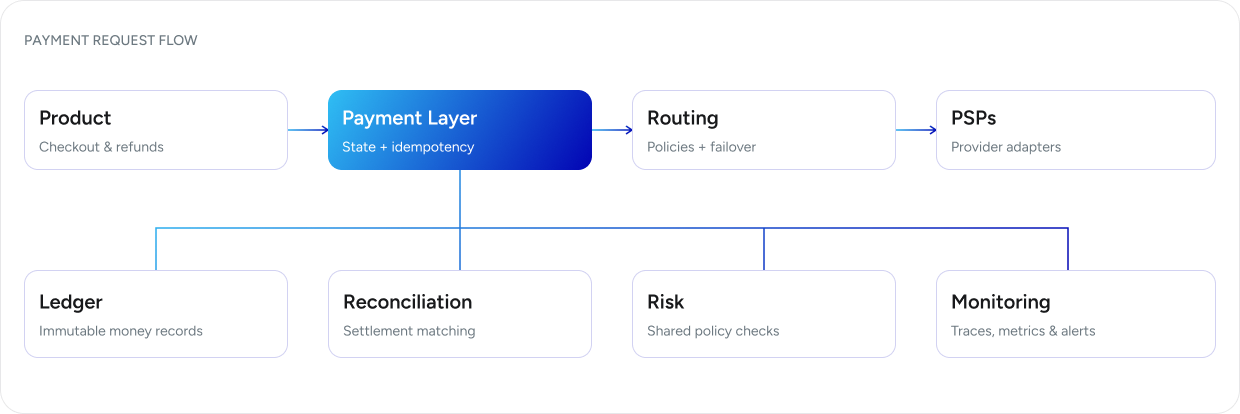
The product submits a stable payment intent; the payment layer owns its lifecycle and idempotency. Routing selects a provider using explicit policies, while risk checks run before authorization. Ledger entries, settlement reconciliation, and end-to-end monitoring remain independent of any one PSP.
Common mistakes
| Mistake | Why it matters | How to avoid |
|---|---|---|
| Building directly around one PSP | Adding a provider means rewriting payment logic | Use one internal payment API from the start |
| Adding reconciliation after launch | Manual work grows with every new provider | Map provider settlement data during onboarding |
| Retrying payments without idempotency | Duplicate charges when failing over | Idempotency keys at the payment layer |
| Keeping routing rules in application code | Every change needs a release | Store routing rules as configuration |
| Using PSP reports as the only source of truth | No single view of your money | Keep an internal ledger |
Planning checklist
Magnise in practice
Payment & Risk Infrastructure
Rebuilding payment infrastructure for a Cross-Border marketplace
A European marketplace (€35M/mo) relied on a single PSP and spreadsheets, losing revenue on failed authorizations.
Platform scope & integrations
89% → 94%
Authorization rate increased through smart routing and automatic cascading, recovering revenue on failed first attempts
-33%
Chargeback rate dropped by about a third once risk scoring moved ahead of authorization instead of after settlement