
The Challenge
A European marketplace processing around €35M a month had built its payments on a single PSP and a spreadsheet. Failed authorizations had no automated retry or cascading path, which meant potentially recoverable transactions were lost, and expansion into new markets stalled because adding a local payment method meant custom integration work each time.
Risk checks ran after settlement, so chargebacks were discovered when the card networks reported them — not prevented. Reconciliation across the PSP, banks, and internal records took the finance team three days after every month-end, and the numbers never matched on the first pass.
The company needed real payment infrastructure: multiple providers behind one interface, risk decisions before authorization, and reconciliation that could run automatically across providers, banks, and internal records.
What we built
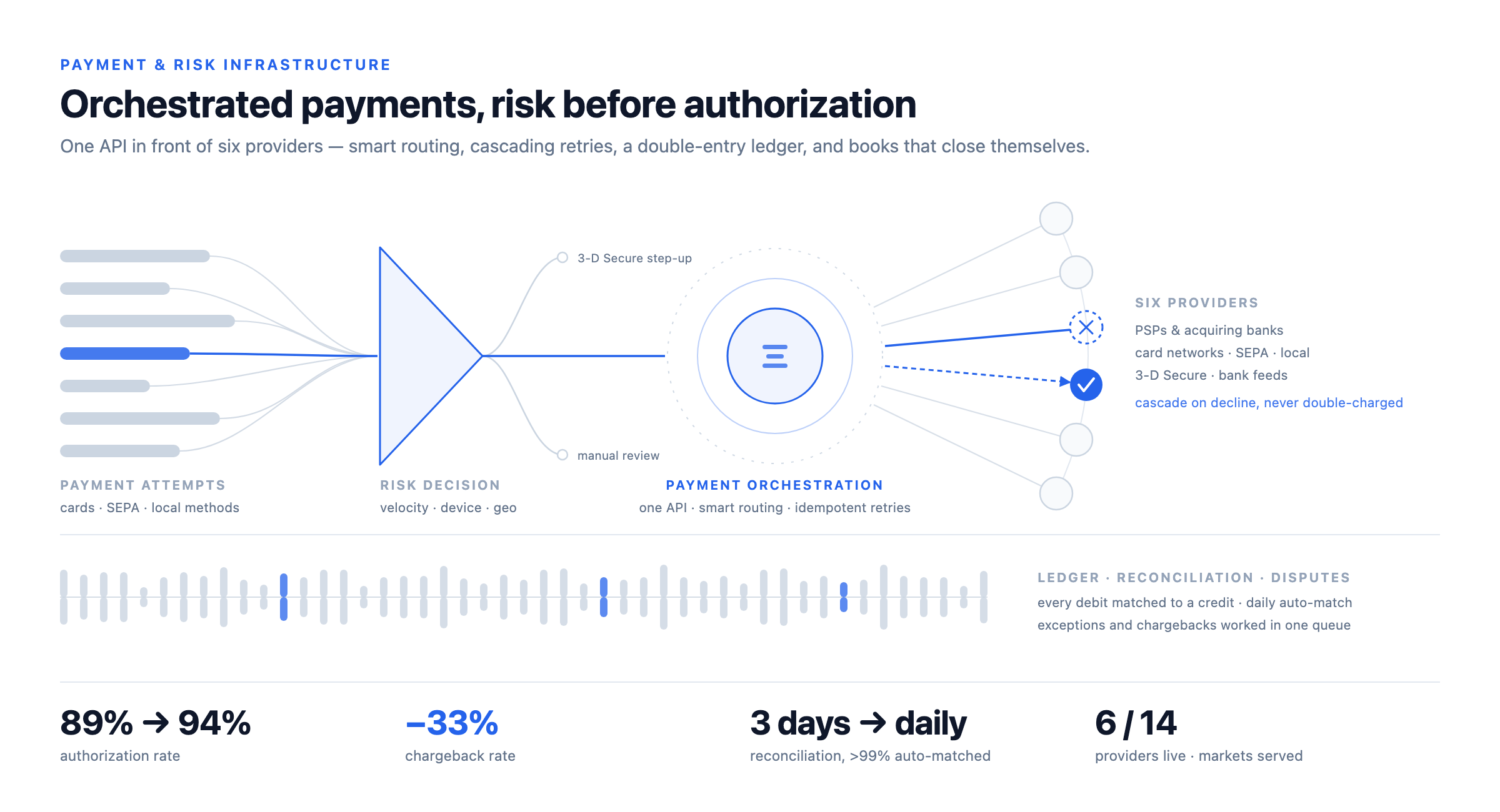
- Payment orchestration layer. One internal payment API in front of multiple PSPs and acquirers, with smart routing by card BIN, currency, and historical provider performance. Failed authorizations cascade to a second acquirer automatically instead of dying on the first decline.
- Transaction ledger. Every payment attempt, capture, refund, and payout recorded in a double-entry ledger — the single source of truth the reconciliation and finance flows run on, not a mirror of provider dashboards.
- Real-time risk scoring. A rules-plus-scoring engine that evaluates every transaction before authorization — velocity checks, device and geography signals, list screening — routing high-risk attempts to 3-D Secure or manual review instead of letting them through to become chargebacks.
- Continuous reconciliation. Provider settlement files and bank statements ingested and auto-matched against the ledger daily, with an exception queue for the finance team instead of a spreadsheet hunt.
- Dispute management. Chargeback intake from providers normalized into one workflow: evidence collection, deadline tracking, and representment — with outcomes fed back into the risk models.
Key integrations
Six payment providers — PSPs and acquiring banks across card networks, SEPA, and local payment methods — plus a KYC/AML provider for merchant onboarding, a 3-D Secure gateway, and bank statement feeds for settlement reconciliation.
The hardest part
Keeping payment state correct across providers that fail in different ways. A cascade from one acquirer to another must never double-charge a customer, no matter which timeout, duplicate webhook, or ambiguous decline happens in between.
We built the orchestration on idempotency keys and an explicit payment state machine: every provider response, including malformed ones, maps to a defined transition, and anything ambiguous parks the payment for automatic status inquiry rather than guessing. Validating the orchestration against provider failures, duplicate webhooks, timeouts, and ambiguous responses was one of the most complex parts of the build.
The outcome
Payments stopped being the reason the company couldn’t enter a market — new providers and payment methods now plug into the orchestration layer instead of the checkout.
- Authorization rate rose from roughly 89% to 94% through smart routing and automatic cascading — recovered revenue on every failed first attempt.
- Chargeback rate dropped by about a third once risk scoring moved ahead of authorization instead of after settlement.
- Reconciliation went from a three-day month-end exercise to a daily automated run with better than 99% auto-matching — finance reviews exceptions, not spreadsheets.
- The platform now routes payments across 6 providers in 14 markets, and the last market launch needed configuration, not integration code.