
About the client
A European proprietary trading firm, founded in 2021 and headquartered in Limassol, running two-step evaluation challenges and instant-funded accounts for retail traders in 90+ countries. By the time Magnise was engaged the firm had issued over 180,000 accounts, with 64,000 active – 47,000 in evaluation and 17,000 funded. The firm is not named here at its request; it operates under a brand well known in the funded-trader market.
The challenge
The firm ran its entire programme through a third-party desktop terminal and a web front end. Its traders were retail and mobile-first – 58% of logins already arrived from mobile browsers onto a UI never designed for them, and 23% of funded accounts were abandoned before placing a first trade.
The deeper problem was risk. Programme rules – daily loss limit, maximum drawdown, position size caps, news-window restrictions – were enforced by back-office jobs running every 15 minutes. A trader could breach a drawdown floor and keep trading for an average of seven minutes before the account was flagged; roughly 1,900 orders a month executed on accounts that had already breached. Each disputed breach became a manual support case, at about 2,400 tickets a month.
Scale at kick-off: 64,000 active accounts, 94 instruments across FX, metals, indices, energies and crypto, 9,200 peak concurrent streaming sessions, ~85,000 aggregate price updates per second.
What we built
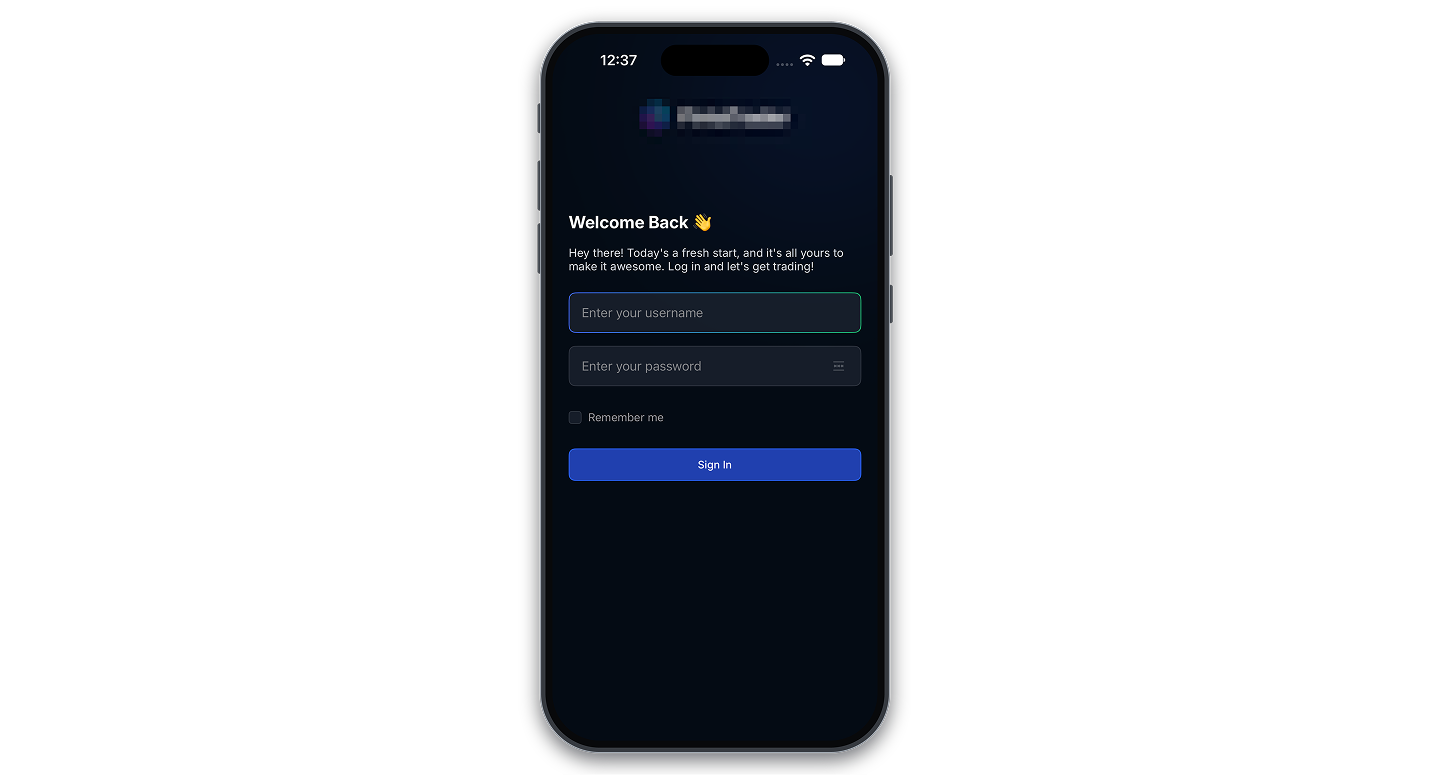
Branded mobile trading client (iOS + Android). One shared application core with a white-label presentation layer – logo, palette, copy, instrument sets and locale-aware number and currency formatting are configuration, not a fork. A new partner-branded build ships without touching trading logic.
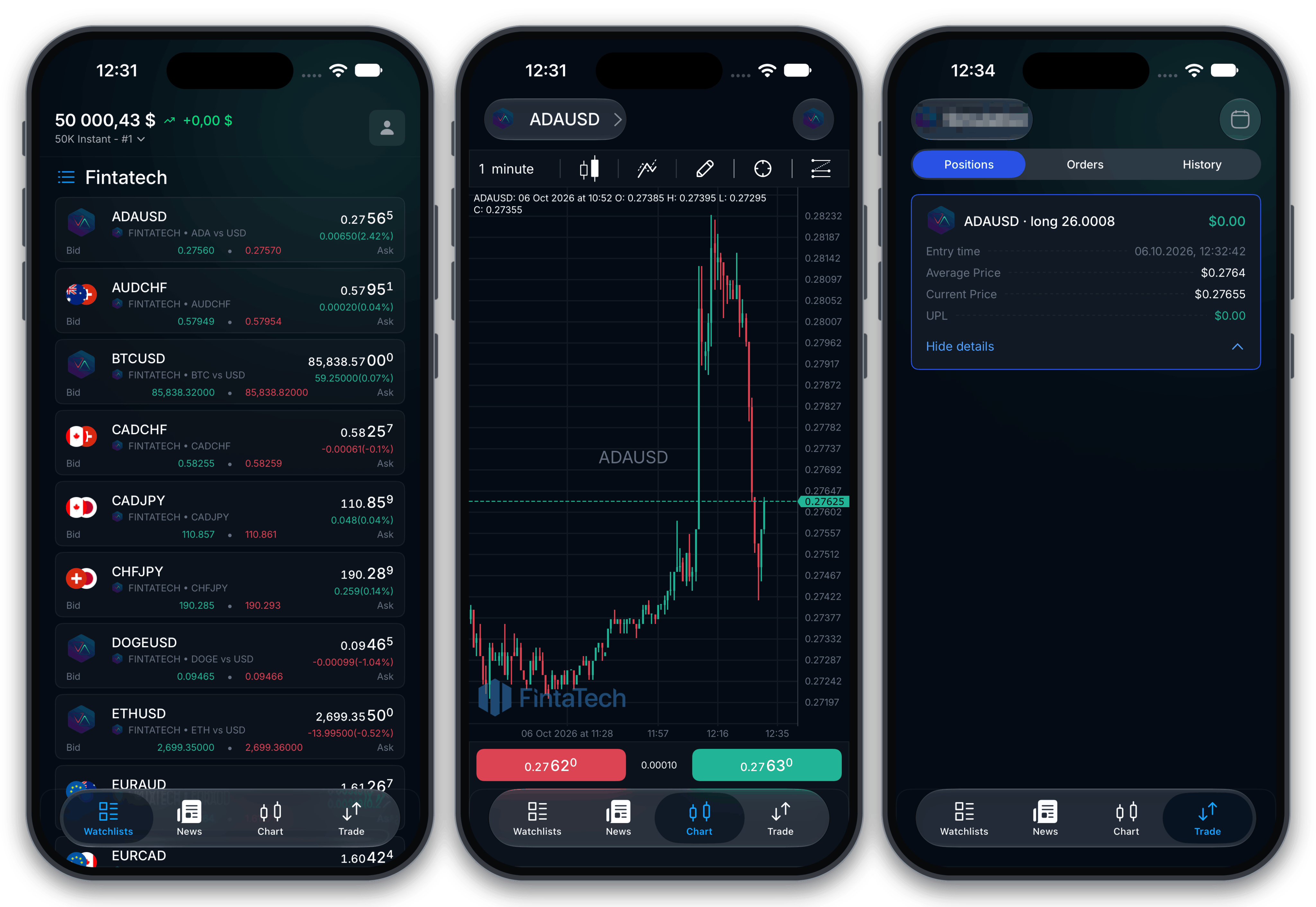
Streaming quote and watchlist service. A single multiplexed connection carries bid, ask, session change and percentage move for every instrument on screen, as delta updates rather than full snapshots – holding a 94-instrument watchlist under 40 kbit/s on a live session. Prices render to the fractional pip, so a trader reads the same precision on a phone as on the desktop terminal. The client resubscribes and re-syncs on reconnect instead of replaying a stale cache.
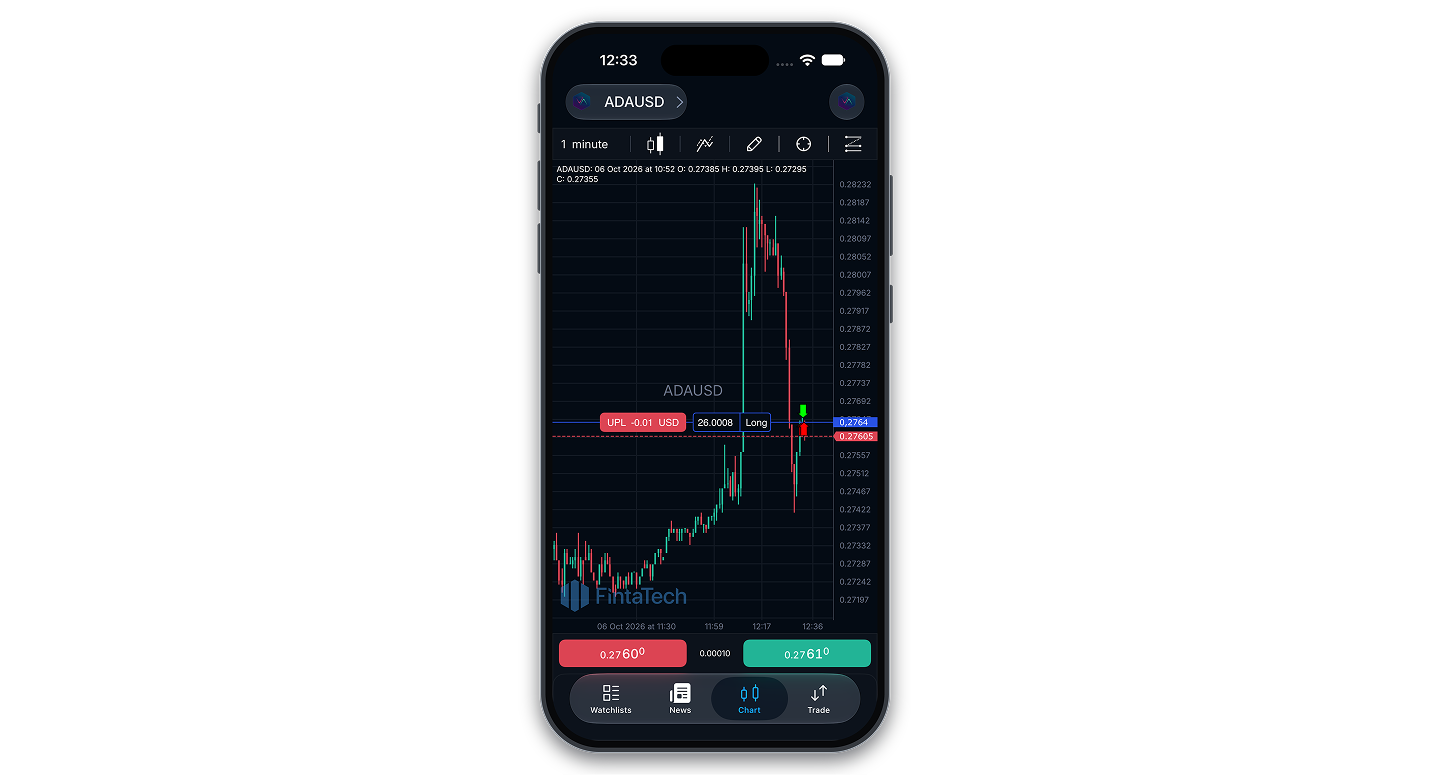
Chart-trading surface. Candlestick charts from one minute upward with indicators, drawing tools and a crosshair, plus one-tap execution on the live bid and ask with the current spread shown between them. Open positions are drawn directly on the chart – average price line, unrealised P&L badge, and draggable take-profit and stop-loss handles – so a trader manages risk in the same view where they read the market.
Pre-trade rule engine on the order path. Programme rules were moved out of back-office batch jobs into an in-line check that every order passes through. The engine evaluates the account’s live equity, daily-loss baseline and drawdown floor against a streaming mark-to-market, and rejects or resizes the order before it reaches the matching core – adding 38 ms at p99 to the order path. The same engine serves mobile, web and API, so a rule cannot be enforced differently depending on where the order came from.
Multi-account identity with simulation parity. One login carries a trader’s evaluation, instant-funded and simulation accounts, switchable from the header. Simulated accounts run through the same order path, the same rule engine and the same blotter as funded ones – what a trader learns in simulation transfers exactly.
Unified blotter and event push. Positions, working orders and history in one place, with entry time, average price, live price and unrealised P&L per position. Fills, rule warnings, margin events and breach notices are pushed from the server, so the app does not have to be open for a trader to learn their account state changed.
Key integrations
Liquidity aggregator and consolidated price feed, the firm’s matching and account core, prop-firm back office and CRM for account issuance and payouts, KYC provider, market news provider, and APNs/FCM for delivery of risk and fill events.
The hardest part
Relocating rule enforcement from a scheduled job to the live order path.
A batch job can afford to be slow and to see a settled picture. An in-line check cannot: it has to decide, per order, whether an account is still inside its daily loss limit and above its drawdown floor – against equity moving continuously with every tick on every open position. Recomputing on demand was not viable at 85,000 updates per second, so equity is maintained as a streaming per-account aggregate, with the daily baseline and the high-water drawdown floor held as derived state that survives restarts and reconciles against the back office each session roll rather than drifting from it. The budget was tight: the check had to fit inside the order path without materially changing fill quality, which put it under 40 ms at p99.
Mobile made it harder. Phone connections drop mid-order, apps get backgrounded during a fill, and a user who sees no confirmation taps again. Order submission had to be idempotent end-to-end so a retried order could not open a second position, and on resume the client had to re-sync position state, unrealised P&L and the on-chart position and TP/SL lines from the server rather than trusting what it held before the gap. A stale position line is not a cosmetic bug on a chart a trader drags a stop onto.
The outcome
- Breach enforcement: up to 15 minutes after the fact (7 min average) → rejected pre-trade, at 38 ms p99 added to the order path.
- Orders executed on already-breached accounts: ~1,900 per month → rejected at submission, removing the category rather than reducing it.
- Breach-related support tickets: ~2,400 per month → ~430 (−82%), because rejections are explained at the point of the order instead of disputed afterwards.
- Mobile adoption: no native app → 61% of trading sessions and 44% of all orders within six months of launch.
- Funded accounts abandoned before first trade: 23% → 14%.
- Partner-branded build lead time: ~6 weeks → 4 days, by configuration rather than a code fork.
- Delivery: 4-week discovery, first TestFlight build at month 4, public release on both stores at month 7, with a team of 7 — 2 mobile, 1 backend, one QA automation, one designer, one DevOps, one PM.