
The challenge
A European consumer neobank had outgrown its MVP core. The first version — a CRUD database with balances stored as mutable rows — got them to market, but by 180,000 accounts it had become a constraint. Wallet balances drifted under concurrent load and required manual correction. Historical balances could not be reconstructed, turning audit requests into engineering projects. Onboarding relied on scripts disconnected from compliance operations, while the back-office team worked directly in database consoles.
The neobank needed to rebuild its core for scale and regulatory scrutiny while keeping the live product running and preserving balance integrity throughout the migration.
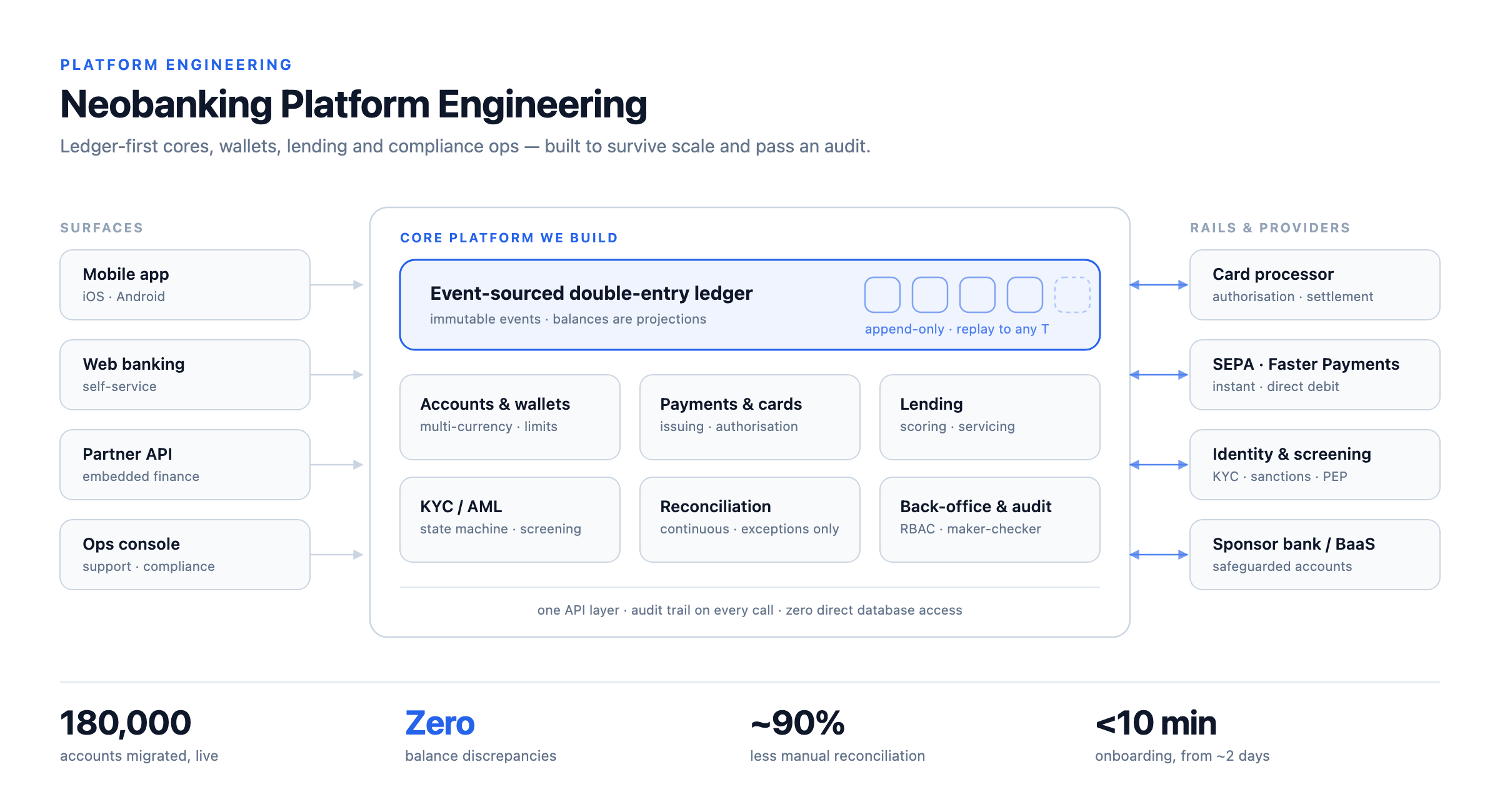
What we built
- Event-sourced ledger and account system. We replaced mutable balance rows with an immutable, append-only event stream. The current balance became a projection; any historical balance can be replayed on demand for an audit. Account types, limits, and fees moved into configuration, so new products no longer require schema changes.
- Wallet engine with continuous reconciliation. Double-entry ledger integrity and distributed locking were introduced to maintain balance consistency under concurrent transactions. Reconciliation against payment providers now runs continuously instead of at month-end.
- KYC/AML onboarding as a state machine. Document parsing, identity verification, and sanctions/PEP screening in one flow, wired directly into compliance routing every case lands in approve, reject, or manual review, with the full decision trail visible to the compliance team.
- Back-office platform. A Customer 360 view, transaction investigation tooling, maker-checker workflows for sensitive operations, RBAC, and immutable audit logging — reducing the need for direct database access in day-to-day operations.
Key integrations
KYC/identity verification provider, sanctions/PEP screening service, card processor, and SEPA payment rails — all connected through the new core’s API layer with audit trails on every call.
The hardest part
Migrating live money. Moving 180,000 accounts from a mutable-row core to an event-sourced ledger meant reconstructing an opening event stream for every account, running both systems in parallel with continuous cross-reconciliation, and cutting over in cohorts. The migration had to preserve balance integrity while avoiding customer-facing downtime. During the parallel run, the new ledger had to match the old system’s balances to the cent every day before any cohort moved.
The outcome
Historical balances can now be reconstructed directly from the event stream, turning audit work that used to take engineering weeks into a query.
- Migrated 180,000 accounts with zero balance discrepancies and no customer-facing downtime.
- Manual reconciliation effort dropped by roughly 90% from a monthly close exercise to continuous automated checks with exception-only review.
- Onboarding time fell from around two days to under 10 minutes for straight-through-processed applications.
- New financial products now launch through configuration in days, instead of core-code releases that took months.